
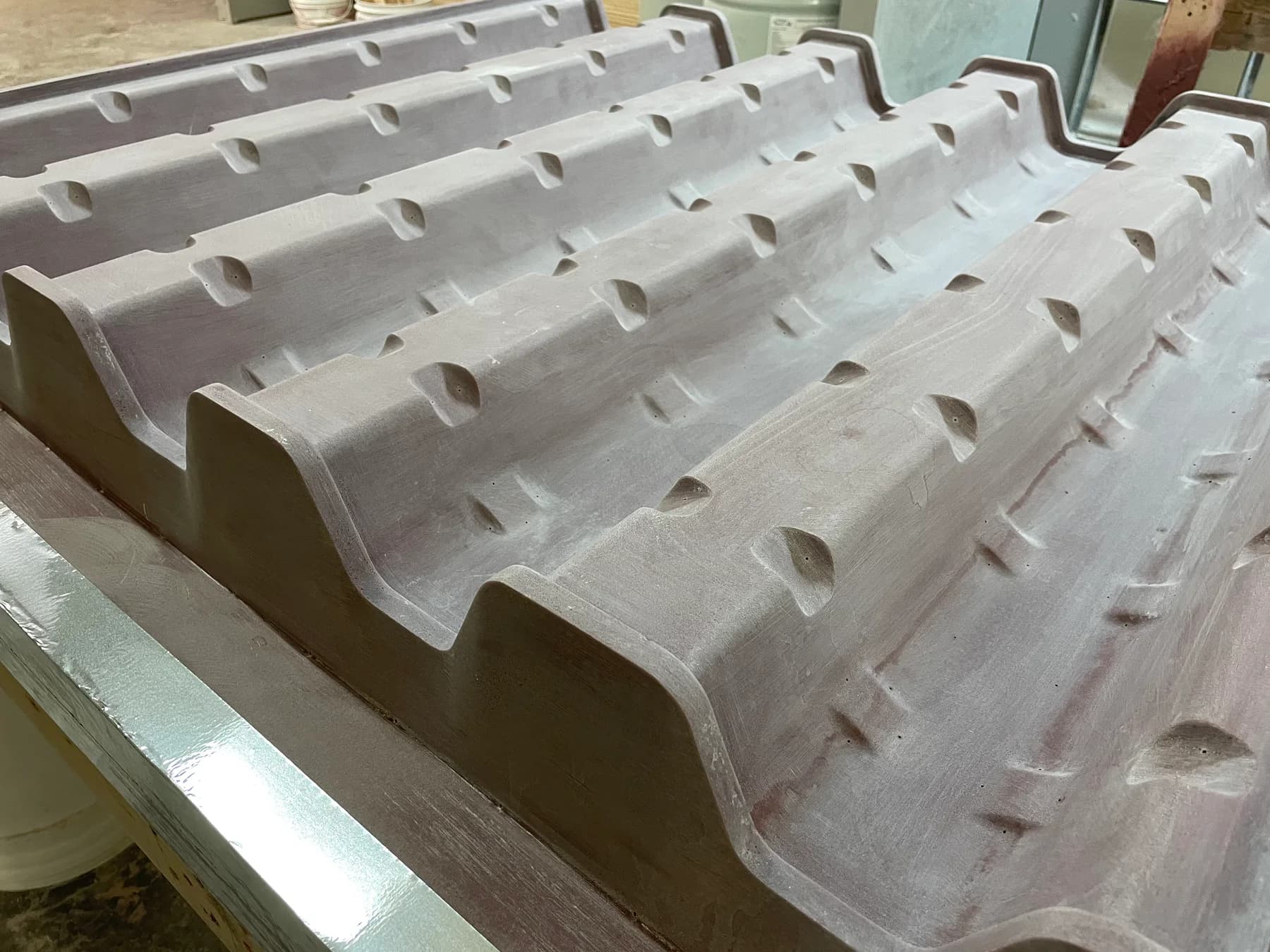
What vacuum forming does
Vacuum forming heats a thermoplastic sheet, brings it over or into a one-sided mold, and removes the air between sheet and tool. Atmospheric pressure pushes the softened material against the mold until the part cools. The formed part is then trimmed, drilled, or finished as required.
Because the process begins with sheet, material stretches through the draw. Part design, starting thickness, pre-stretching or plug assists, temperature control, and geometry all affect the final wall distribution.
What injection molding does
Injection molding melts polymer feedstock and forces it into a closed mold. The material cools in the cavity, the mold opens, and the part is ejected. Runners, gates, parting lines, ejectors, cooling, and shrink behavior are part of the mold and part-design problem.
Closed injection molds can produce detailed geometry on multiple faces and are built around repeatable molding cycles. The tooling and process are fundamentally different from the one-sided tools used in vacuum forming.
Often worth evaluating when:
- The part is a panel, housing, liner, cover, tray, or other sheet-based form
- Large part size makes a sheet process attractive
- One controlled mold surface fits the appearance and tolerance plan
- Trimming and secondary operations are acceptable parts of production
Often worth evaluating when:
- The part needs closed-mold detail or features on several faces
- Ribs, bosses, attachments, or repeatable molded detail drive the design
- The expected production program can support the tooling and process
- The molder’s material and automation strategy fits the application
Do not choose by volume alone
It is tempting to reduce the choice to a single production-quantity breakpoint. That number is not universal. Part size, geometry, material, tooling complexity, trim labor, surface requirements, expected program life, change risk, and the capabilities of the selected processor all affect the economics.
The better early question is whether the part naturally behaves like a formed sheet or a closed-mold component. A thermoformer or injection molder can then evaluate production around the real geometry and forecast.
If vacuum forming is the likely route, send the part and production information to Prestige for a tooling conversation.